
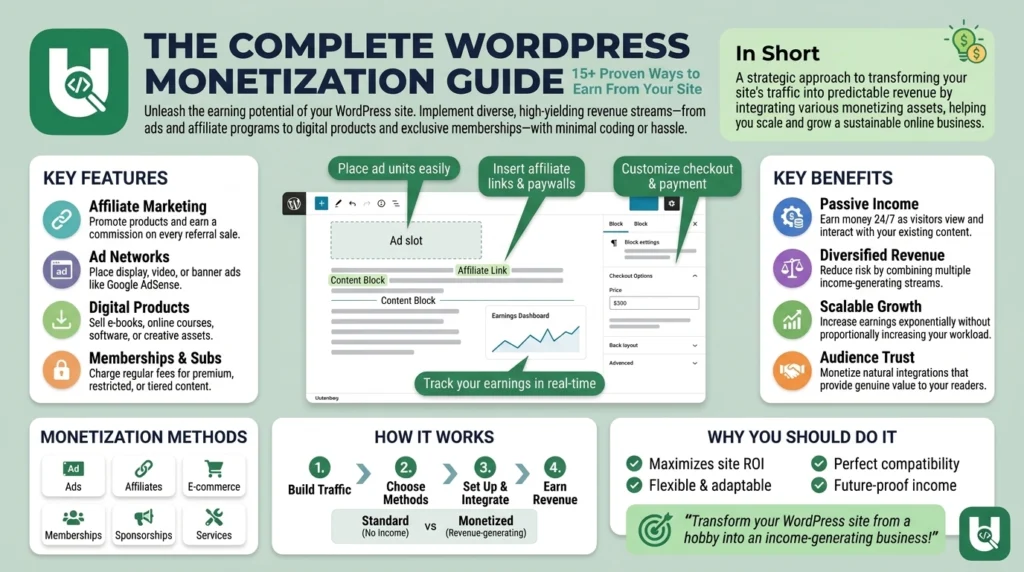
WordPress powers over 40 percent of the internet, and a significant portion of those sites are built with one goal in mind: generating income. Whether you are a blogger looking for passive revenue, a creator packaging your expertise, or a business owner building a sales engine, WordPress gives you the infrastructure to support almost every monetization model in existence.
This guide covers the complete Monetization Strategy Overview for WordPress, from the simplest display ad setup to sophisticated membership communities, digital product stores, and service-based income systems. More importantly, it shows you how to think about monetization strategically, matching the right model to your audience, your content, and your long-term goals.
Part 1: How to Think About WordPress Monetization
Audience Intent Mapping
Before choosing a monetization method, the most important work you can do is Audience Intent Mapping. The question is not what you want to sell. The question is what your visitors are actually looking for when they land on your site. An audience researching product comparisons has high commercial intent and responds well to affiliate content. An audience seeking tutorials and how-to guides is building skills, which makes digital products and courses a natural fit. An audience following your personal story is emotionally invested, which makes memberships and direct support models work.
Matching your monetization model to your audience’s intent is the single biggest factor in whether your earnings grow consistently or plateau early.
Traffic vs Conversion Balance
A common mistake among new site owners is focusing entirely on growing traffic while ignoring conversion rate. Traffic vs Conversion Balance matters because your revenue is the product of both, not just one. A site with 10,000 monthly visitors and a 2 percent conversion rate earns more than a site with 50,000 visitors and a 0.1 percent conversion rate. Conversion Rate Optimization through better call-to-action placement, clearer value propositions, and improved page flow often delivers faster revenue growth than chasing additional traffic.
The healthiest monetization strategy builds both simultaneously: using SEO Organic Traffic for sustainable long-term growth while continuously improving the conversion systems that turn visitors into customers.
Passive Income Scaling and Traffic Source Diversification
The goal most bloggers and creators are working toward is Passive Income Scaling, where income continues to grow without proportional increases in active work. This is achievable in WordPress through layered monetization systems: SEO content that generates affiliate income around the clock, automated email sequences that sell digital products, and membership platforms that collect recurring revenue every month.
Traffic Sources Diversification protects this system from collapse. Over-dependence on a single traffic source, especially Google organic search, creates fragility. A well-diversified traffic strategy combines SEO, social media, email marketing, and potentially YouTube or podcast content into a multi-channel system where no single platform failure destroys your income.
Niche Selection and Profitability
Niche Selection is foundational to monetization potential. Not all topics earn equally. Finance, software, health, and business niches typically generate higher affiliate commissions and CPM rates than general lifestyle content. This does not mean you should abandon your topic of genuine expertise, but it does mean understanding the earning ceiling of your niche and choosing monetization methods suited to its audience. A gardening blog will rarely earn through high-ticket software affiliate links, but it can build a strong membership community, sell digital planting guides, or offer coaching services effectively.
Part 2: Display Advertising
Google AdSense and the CPC Revenue Model
Google AdSense is the most widely used display advertising platform for WordPress sites, particularly for newer blogs building their traffic base. AdSense uses a CPC Revenue Model (cost per click) where you earn a share of the advertising revenue each time a visitor clicks an ad displayed on your pages. AdSense also pays on a CPM (cost per thousand impressions) basis for certain ad types.
The AdSense approval process requires a site with original content, a clean design, and compliance with Google’s content policies. Most sites need several weeks to a few months of consistent content publishing before approval. Once approved, ads are placed through a simple code snippet or the official AdSense WordPress plugin.
Advertising Revenue and Passive Revenue Scaling
Advertising Revenue through display ads scales directly with traffic volume. RPM (revenue per thousand pageviews) is the metric that determines your actual earnings, and it varies significantly by niche, geographic audience, and ad network. High-traffic sites in finance, technology, and health niches can earn RPMs of $15 to $40 or more. General content sites often see RPMs of $2 to $8.
For sites with meaningful traffic, premium ad networks like Mediavine (50,000 monthly sessions minimum) and Ezoic offer significantly higher RPMs than AdSense by using more sophisticated ad optimization. Passive Revenue Scaling through advertising depends on growing organic traffic consistently over time, which makes Blog Speed Optimization and Core Web Vitals compliance critical, since slow-loading ad scripts can reduce both user experience and ranking performance simultaneously.
Ad Placement Strategy
Ad placement significantly affects both revenue and user experience. Effective placement strategies include:
- In-content ads placed after the second or third paragraph, where readers are engaged
- Sticky sidebar ads that remain visible as visitors scroll
- Header banner ads for high-visibility placement above the fold
- Between-section ads on long-form content pieces
- Avoiding ad placements that interfere with navigation or content readability
Part 3: Affiliate Marketing
Affiliate Marketing Strategy
Affiliate Marketing is the most scalable content-based monetization model for WordPress sites. You earn a commission each time a visitor clicks your affiliate link and completes a purchase. The commission structure, conversion window, and earning potential vary by program, but well-chosen affiliate partnerships in the right niche can generate substantial income from a relatively modest traffic base.
The model works because it aligns your content naturally with your readers’ needs. When you recommend products or tools you genuinely use and believe in, your recommendations carry authority. When you optimize for High-Intent Content like comparison articles, product reviews, and tool roundups, you attract visitors who are already close to a purchase decision.
Amazon Associates
Amazon Associates is the most accessible affiliate program for beginners because Amazon sells nearly everything, making it easy to link naturally from almost any content niche. Commission rates are modest, typically 1 to 10 percent depending on product category, but Amazon’s conversion rate is unusually high because visitors already trust the platform. The limitation is a short 24-hour cookie window, which means you only earn if the purchase happens within a day of the click.
Affiliate Product Reviews and Comparison Content
Affiliate Product Reviews and comparison articles are the highest-converting content formats for affiliate income. A well-structured review article covers the product’s core use case, key features, limitations, pricing, and who it is best suited for. Conversion Rate Optimization for affiliate content means placing affiliate links early in the article (not just at the end), using clear call-to-action buttons rather than plain text links, and including comparison tables that help readers make faster decisions.
Transparency matters. Every piece of affiliate content on your site should include a clear disclosure that you may earn a commission from purchases made through your links. This is both a legal requirement in most jurisdictions and a trust signal that actually improves conversion rates by demonstrating honesty.
Part 4: Digital Products
Digital Products Strategy
Digital Products Strategy is built around one fundamental advantage: once created, a digital product can be sold an unlimited number of times with no additional production cost. This makes digital products one of the highest-margin monetization models available on WordPress. Common digital products include ebooks, PDF guides, templates, presets, spreadsheets, design assets, stock photos, and downloadable tools.
The key to a successful digital product is specificity. A broad ebook rarely sells as well as a highly specific, actionable guide that solves a single well-defined problem for a clearly defined audience. Your existing content gives you a map of what your audience is already reading and engaging with, which tells you exactly what problem they most want solved.
Online Courses and Educational Monetization
Online Courses represent the high-ticket end of digital product monetization. A well-structured course that delivers a clear transformation, teaching a specific skill or helping students achieve a specific outcome, commands pricing from $97 to $2,000 or more depending on the depth, niche, and included support.
WordPress supports course delivery through dedicated Learning Management System plugins. The three most widely used are:
LMS Plugin Comparison for WordPress
| Feature | LearnDash | TutorLMS |
| Course Structure | Lessons, topics, quizzes | Lessons and quizzes |
| Membership Hybrid | Via add-on | Built-in (LifterLMS) |
| Pricing Model | $199/yr+ | Free + Pro $149/yr |
| WooCommerce Integration | Yes | Yes |
| Certificates | Yes | Yes |
| Best For | Advanced course creators | Beginners and educators |
LearnDash Integration is the most popular choice for professional course creators who need granular control over Course Delivery System structure, drip content scheduling, and advanced quiz logic. TutorLMS Integration offers a more accessible Education Workflow with a strong free version. LifterLMS Integration is designed for a Membership Learning Hybrid model where course access is bundled with membership tiers, making it suited for creators who want to combine structured learning with community access.
Checkout Optimization for Digital Products
Checkout Optimization is critical for digital product sales because every unnecessary step between the decision to buy and the completed purchase reduces conversion. Best practices for digital product checkout on WordPress include:
- Use a single-page checkout that collects only essential information
- Display security badges and payment method icons near the checkout button
- Offer multiple payment options including credit card, PayPal, and Stripe
- Show a clear order summary with product name, price, and delivery method
- Send an immediate confirmation email with the download link
SureCart has emerged as a popular Lightweight Monetization Stack for WordPress creators who want clean checkout experiences without the complexity of full WooCommerce setup. It is optimized specifically for digital products and simple service sales, with a checkout-first architecture that minimizes the plugin footprint.
Part 5: Membership Sites and Subscription Revenue
Membership Models
Membership Models create recurring revenue by giving subscribers access to exclusive content, tools, community, or experiences in exchange for a monthly or annual fee. This is one of the most valuable monetization structures available because it generates predictable income and builds an audience that is genuinely invested in your work.
WordPress supports membership functionality through plugins like MemberPress, Paid Memberships Pro, and Restrict Content Pro. These tools handle subscription billing, access restriction, member management, and integration with payment gateways.
Subscription Website Structure
A Subscription Website typically offers content or community access at multiple price points. A common three-tier structure works like this:
- Free tier: Public content available to all visitors, serving as a conversion funnel into paid tiers
- Basic paid tier: Access to a content library, resource downloads, or a community forum
- Premium paid tier: Direct access to you through live sessions, personalized feedback, or advanced tools
The free tier is the discovery layer that converts visitors into members. It should demonstrate enough value that upgrading feels like an obvious next step, not a gamble.
Email List Building as a Retention Engine
Email List Building is the most important supporting system for any membership or product-based monetization model. An email list gives you direct access to your audience independent of any platform algorithm. Email Marketing sequences turn first-time visitors into buyers by delivering value over multiple touchpoints before presenting an offer.
Effective Audience Monetization Funnel design through email typically follows this flow: a lead magnet attracts new subscribers, an automated welcome sequence delivers immediate value and builds trust, and targeted campaign emails introduce paid offers at the right moment. The list itself is a monetization asset that compounds in value as it grows.
Part 6: Sponsored Content and Brand Partnerships
Sponsored Posts and Brand Collaboration
Sponsored Posts are articles, videos, or other content that brands pay you to publish on your site. Unlike affiliate marketing, where you earn based on performance, sponsored content pays a flat fee regardless of how many sales result. This makes it predictable and well-suited to sites with strong audience engagement even if they are not optimized for commercial traffic.
Sponsored Content Pricing is determined by your site’s domain authority, monthly traffic, niche relevance, and audience engagement metrics. A niche site with 20,000 monthly readers and high engagement in a specific industry can command higher sponsored post rates than a general site with 100,000 monthly visitors and low engagement. Create a media kit that documents your traffic, audience demographics, engagement rates, and examples of previous collaborations.
Content Quality and E-E-A-T
Content Quality drives monetization outcomes across every channel. Google’s E-E-A-T framework (Experience, Expertise, Authoritativeness, and Trustworthiness) is directly tied to organic ranking, which is the foundation of most traffic-dependent monetization models. High-quality content that demonstrates genuine expertise earns better rankings, attracts better brand partnerships, commands higher ad RPMs, and converts affiliate readers at higher rates. Content quality is not a soft metric; it is a direct revenue driver.
Part 7: Service-Based Monetization
Service-Based Monetization for Freelancers and Agencies
Service-Based Monetization turns your WordPress site into a client acquisition system. For freelancers, consultants, coaches, and agencies, the site serves as a portfolio, credibility builder, and lead generation engine rather than a direct revenue source. Revenue comes from the services the site sells, not from the site’s traffic directly.
Freelance Services and Portfolio Structure
Freelance Services pages should be structured around outcomes rather than deliverables. Instead of listing what you do, lead with what changes for the client after working with you. A case study section showing before-and-after results for previous clients builds trust more effectively than a list of services. Include testimonials, a clear pricing or inquiry structure, and a prominent call-to-action that makes it easy for visitors to start a conversation.
Coaching Services and Booking Integration
Coaching Services monetization works well on WordPress through booking plugin integrations that let potential clients see your availability and schedule a discovery call or paid session directly from your site. Tools like Calendly, BookingPress, and Amelia integrate with WordPress and reduce the back-and-forth friction that loses potential clients between initial interest and confirmed booking.
Website Maintenance Services
Website Maintenance Services represent a recurring revenue model for developers and agencies. Monthly maintenance packages covering WordPress core updates, plugin updates, backups, security monitoring, and performance checks create stable predictable income. WordPress’s own Plugin Ecosystem Monetization infrastructure makes it straightforward to build automated maintenance workflows, and many agencies use tools like MainWP or ManageWP to manage multiple client sites efficiently from a single dashboard.
Part 8: E-commerce and Physical Products
WooCommerce and Full E-commerce Systems
WooCommerce is the dominant e-commerce platform for WordPress, powering over 30 percent of all online stores globally. It handles Physical Product Selling through a complete feature set including product pages, variant management, inventory tracking, shipping calculation, tax configuration, and payment gateway integration. WooCommerce’s extensibility through thousands of official and third-party extensions means it can be configured for virtually any retail use case.
Dropshipping Model
The Dropshipping Model allows you to sell physical products without holding inventory. Orders placed on your WooCommerce store are automatically forwarded to a supplier who ships directly to your customer. Plugins like AliDropship and Spocket integrate directly with WooCommerce to automate this workflow. The primary advantages are low startup cost and no inventory risk. The primary challenges are lower margins, longer shipping times, and quality control limitations.
Marketplace Creation with Multi-Vendor Setup
Marketplace Creation takes the e-commerce model further by enabling multiple vendors to sell through your WordPress site, similar to Amazon or Etsy. The Dokan plugin combined with WooCommerce is the most common stack for this model. Each vendor gets their own dashboard to manage products, orders, and payouts, while you earn a commission on every sale made through the platform. This model requires more development and management overhead but creates a scalable income stream that grows as more vendors join.
Donation System
The Donation System model suits content creators, nonprofits, and passion-driven publishers who want to let their audience support their work directly. WordPress integrates with platforms like Buy Me a Coffee, Ko-fi, and PayPal Donate through simple plugin integrations or embedded buttons. A transparent explanation of how donations support your work, placed naturally within content that demonstrates your value, converts more effectively than a generic donate button in a sidebar.
Part 9: Content and Media Monetization
YouTube Channel Monetization and Content Strategy
YouTube Channel Monetization extends the WordPress monetization ecosystem by creating a video channel that drives traffic back to your site. A WordPress site serves as the hub for your video content strategy: hosting extended versions of YouTube content, embedding videos within monetized blog posts, building email opt-ins around video content, and selling products or services to a video-warmed audience. The SEO content published on WordPress and the video content on YouTube reinforce each other’s authority.
Podcast Monetization
Podcast Monetization on WordPress combines audio content distribution with the full monetization toolkit of your site. WordPress podcast hosting plugins like Seriously Simple Podcasting and PowerPress embed audio players directly into posts. Podcast audiences are highly engaged and tend to have strong loyalty to their preferred shows, making them responsive to direct sponsorship mentions, affiliate recommendations, and community membership offers. The combination of podcast content and affiliate marketing is particularly effective in business, technology, and self-improvement niches.
Advertising Revenue Through Multiple Channels
Advertising Revenue does not need to come from a single network. A sophisticated Traffic Monetization Mix might combine Google AdSense or a premium ad network for display ads, direct banner ad sales to niche-relevant advertisers at rates you set, sponsored newsletter placements to an email subscriber list, and sponsored podcast segment reads. Each channel adds an income layer that operates somewhat independently, reducing dependency on any single advertiser or network.
Part 10: Analytics, Branding, and Long-Term Growth
Analytics Tracking and Performance Measurement
Analytics Tracking is not optional for a monetized WordPress site. Every monetization decision should be backed by data. Google Analytics 4, combined with event tracking for affiliate clicks, form submissions, and purchase completions, gives you the data needed to understand which content drives revenue, which traffic sources convert, and where visitors drop off before completing a goal. Passive Income Scaling requires this feedback loop to work: you scale what works and fix or retire what does not.
Content Clustering and SEO Architecture
Content Clustering is the SEO strategy that builds the topical authority your monetization depends on. A pillar page covering a broad topic in depth is supported by cluster pages covering related subtopics. Internal links from cluster pages to the pillar page concentrate link equity and signal topical expertise to search engines. This Content Marketing Strategy is the most reliable long-term driver of the organic traffic that makes most monetization models possible.
Branding and Authority Building
Branding and Authority Building is the foundation that makes every other monetization method more effective. A recognized personal or business brand commands higher affiliate conversion rates, attracts better brand partnerships, sells digital products at premium prices, and retains members longer. Authority is built through consistent publishing of genuinely useful content, demonstrating real experience and expertise, engaging meaningfully with your community, and maintaining a consistent voice and visual identity across every touchpoint.
Plugin Stack Risk Management
As your WordPress site becomes a revenue-generating asset, Plugin Stack Risk becomes a business concern. Each plugin is a dependency that can introduce compatibility issues, security vulnerabilities, or performance problems. A bloated plugin stack that includes multiple overlapping tools, inactive plugins left installed out of habit, and poorly maintained plugins with infrequent updates creates unnecessary risk for a site that is actively earning income. Audit your plugin library regularly and maintain the minimal effective stack that delivers your required functionality.
WordPress Monetization Model Comparison
| Monetization Model | Startup Effort | Income Type | Best For |
| Display Ads (AdSense) | Low | Passive | High-traffic content blogs |
| Affiliate Marketing | Medium | Passive / Semi-passive | Niche review and comparison sites |
| Digital Products | Medium | Passive after launch | Educators, designers, creators |
| Online Courses | High | High ticket passive | Coaches, subject matter experts |
| Membership Sites | High | Recurring / Predictable | Community builders, niche experts |
| Sponsored Content | Low-Medium | Active per deal | Authority niche sites |
| Freelance / Coaching | Low | Active service income | Developers, consultants, coaches |
| WooCommerce Store | High | Active / Scalable | Product-based businesses |
| Dropshipping | Medium | Active / Scalable | Low-inventory e-commerce startups |
| Podcast / YouTube | Medium-High | Mixed revenue streams | Content creators with audiences |
WordPress Monetization Best Practices Checklist
- Map your audience’s intent before selecting a monetization model
- Build an email list from day one. It is your most resilient monetization asset
- Invest in SEO and content clustering before expecting significant passive income
- Choose a reliable hosting provider that supports your site’s performance as traffic grows
- Optimize every checkout flow for minimal friction and maximum trust signals
- Diversify traffic sources across SEO, email, social, and video to reduce dependency risk
- Review your analytics monthly and double down on the content that drives actual revenue
- Test CTAs, headlines, and pricing through systematic optimization
- Keep your plugin stack minimal and your site performance optimized
- Build authority and brand recognition consistently. It compounds over time
Pro Tip: Start with one monetization model, optimize it until it works, then layer in additional income streams. Trying to implement everything at once typically results in none of them working well.
Frequently Asked Questions About WordPress Monetization
1. What is the best monetization method for a new WordPress blog?
For most new blogs, affiliate marketing is the best starting point because it does not require product creation, has no minimum traffic threshold for many programs, and can generate income from relatively modest visitor numbers if the content targets commercial intent keywords. Display advertising through AdSense is an alternative but typically generates meaningful income only after reaching 10,000 or more monthly pageviews. The most important first step regardless of method is building an email list from your first published post.
2. How much traffic do I need to make money from my WordPress site?
There is no universal threshold because it depends entirely on your monetization model. Affiliate marketing can generate income with a few hundred highly targeted visitors per month if the content matches commercial intent. Display ads require significantly more traffic, typically 10,000 or more monthly sessions for meaningful earnings. Digital products and coaching services can generate income with small, highly engaged audiences. The quality and intent of your traffic matters far more than the raw number of visitors.
3. What is the difference between active and passive income on WordPress?
Active income requires your ongoing involvement to generate each dollar: freelance services, coaching, and one-on-one consulting are active income. Passive income continues to earn without proportional ongoing effort: affiliate commissions from articles you wrote months ago, digital product sales from a course you created once, and ad revenue from content published in the past are all passive. Most successful WordPress monetization strategies combine both: active income provides stability in the early stages while passive income systems are being built.
4. Do I need WooCommerce to sell products on WordPress?
WooCommerce is the most comprehensive option for selling physical products, but it is not the only one. For digital products, simpler solutions like Easy Digital Downloads, SureCart, or WooCommerce with a digital downloads extension are more appropriate and less complex. For simple one-product sales, a third-party payment processor like Stripe with a WordPress payment plugin is often sufficient. WooCommerce makes sense when you need a full catalog, inventory management, multiple shipping options, and complex product variants.
5. How do membership sites work on WordPress?
Membership sites restrict specific content to paying subscribers using a membership plugin like MemberPress, Paid Memberships Pro, or Restrict Content Pro. The plugin integrates with your payment gateway to collect recurring monthly or annual fees and automatically grants or revokes access based on subscription status. Members log in to access restricted content, community areas, or downloadable resources. The most successful membership sites provide genuine ongoing value that gives members a clear reason to stay subscribed month after month.
6. What is the role of SEO in WordPress monetization?
SEO is the primary traffic source for most WordPress monetization models and the foundation that everything else is built on. Organic search traffic is free, highly targeted, and scalable over time. Content clustering, topical authority building, and keyword targeting bring in visitors who are actively searching for what you offer, which makes them significantly more likely to engage with affiliate content, buy digital products, or sign up for membership access. Without consistent SEO investment, most WordPress monetization models are dependent on paid traffic or social media algorithms, neither of which is as reliable or cost-effective as organic search over time.
7. How should I price my digital products or online courses?
Pricing should reflect the transformation or outcome your product delivers, not the time it took you to create it. A short guide that solves a high-value problem can be priced higher than a lengthy course that teaches broadly useful but low-urgency skills. Research what competitors in your niche charge, but do not simply match their prices. Test different price points with a small audience before committing to a public price. Many creators price too low out of uncertainty. If your refund rate is very low and conversion rates are reasonable, your price is probably not too high.
8. What hosting provider should I use for a monetized WordPress site?
A monetized WordPress site is a business asset and should be hosted on infrastructure appropriate to that status. Shared hosting is too unreliable and slow for sites actively generating income. Managed WordPress hosting from providers like WP Engine, Kinsta, Flywheel, or Cloudways provides the performance reliability, automatic backups, staging environments, and security infrastructure that a monetized site requires. The hosting cost is a small fraction of the revenue a well-performing site generates, and the performance improvements from better hosting directly affect ad RPM, conversion rates, and SEO rankings.